How to Use Virtual Reality for Home Workouts: A Beginner’s Guide
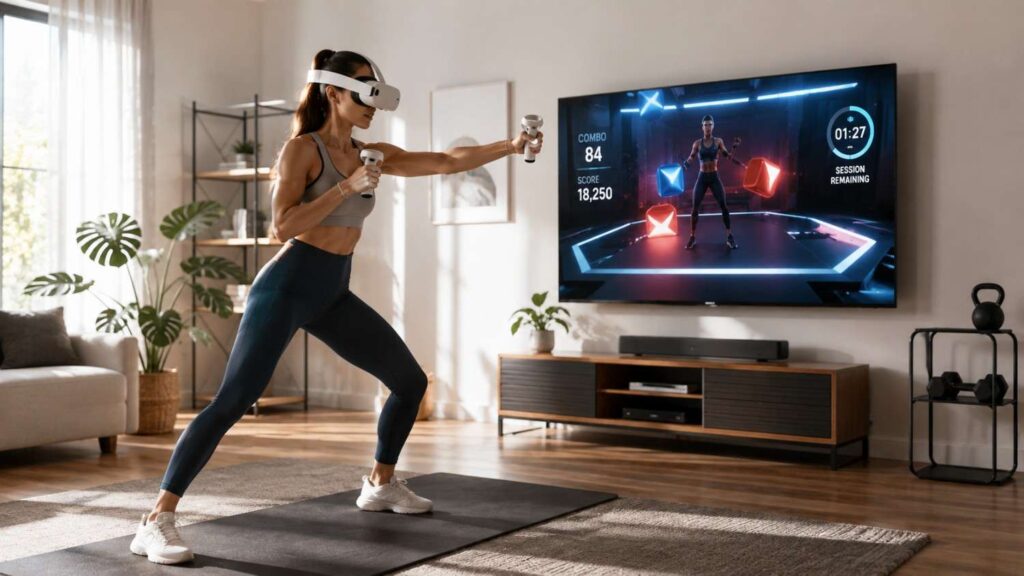
Home exercise has changed significantly as fitness technology has become more interactive. Instead of simply watching an instructor on a television or following a workout timer on a phone, virtual reality allows you to physically interact with a digital environment. You might punch targets in a boxing session, move to music in a rhythm game, duck under obstacles, perform squats, or follow a virtual coach without leaving your home.
That immersive element is what separates virtual reality workouts from conventional workout videos. The headset responds to your movements in real time, and many applications use scores, targets, coaching, music, visual feedback, progression systems, or changing environments to make physical activity more engaging. For someone who finds repetitive indoor exercise difficult to maintain, this can be a meaningful advantage.
However, learning how to use virtual reality for home workouts involves more than putting on a headset and launching a game. The quality of the workout depends on the type of application you choose, the amount of physical movement it requires, your technique, your available space, and how the activity fits into your wider fitness routine.
Researchers often describe movement-based gaming as exergaming, which combines physical exercise with elements of interactive games. A systematic review of 29 studies found that some exergaming activities can reach moderate or vigorous exercise intensity and may make exercise feel more enjoyable. The review also noted that evidence around long-term adherence is still developing.
The practical takeaway is simple: VR can be useful exercise technology, but it is not automatically effective just because it feels active. A thoughtful setup and a balanced training approach matter.
What Are Virtual Reality Home Workouts?
Virtual reality home workouts are interactive exercise experiences in which physical movements control what happens inside a digital environment. Instead of passively viewing instructions, you actively respond to virtual targets, coaches, music, opponents, objects, or challenges using a VR headset and compatible tracking technology.
The level of exercise can vary dramatically. Some applications are designed specifically for fitness and contain structured sessions, coaching, intensity levels, progress tracking, and recovery options. Others are entertainment-focused games that happen to require enough physical movement to raise your heart rate. A fast boxing experience, for example, may demand frequent punches, defensive movements, and squats, while a seated puzzle game may involve almost no meaningful exercise.
This distinction matters when evaluating a VR home workout. The label “virtual reality” tells you how the experience is delivered, not how physically demanding it will be. You still need to consider exercise intensity, duration, movement patterns, and how frequently you use it.
For beginners, the best approach is to think of VR as a delivery system for movement. Some experiences are closer to traditional workouts, while others resemble active games. Both can have value, but they should be judged according to what your body is actually doing rather than how exciting the virtual environment appears.
| VR Fitness Element | Role in Home Workouts | User Benefit |
|---|---|---|
| Motion Tracking | Detects body movements in real time | Improves workout accuracy |
| Immersive Environment | Creates interactive fitness experiences | Increases motivation |
| Guided Training | Provides structured workout sessions | Makes exercise easier to follow |
| Active Gameplay | Combines gaming with physical activity | Makes workouts more engaging |
| Progress Monitoring | Tracks workout activity | Encourages consistency |
| Room-Scale Movement | Allows full-body interaction | Supports natural movement patterns |
How Does VR Fitness Work?
VR fitness works by combining a headset’s tracking technology with software designed to respond to physical movement. The headset tracks the position and orientation of your head, while controllers, hand tracking, or other sensors can detect actions such as reaching, punching, swinging, or pointing. The application then translates those movements into activity inside the virtual environment.
A good example is Supernatural. Its official information describes Boxing workouts containing punches such as jabs, crosses, hooks, and uppercuts, while defensive obstacles encourage users to slip, duck, bob, and weave. Its Flow sessions add strikes and lower-body movements including squats and lunges. Supernatural also calibrates certain movements using measurements such as height, arm span, squat depth, and lunge width.
This feedback loop is important. Instead of performing movements with no immediate response, users see targets break, scores change, obstacles move, or instructions appear based on what they do physically. That interaction can make repetitive exercise feel more purposeful.
Still, tracking technology cannot judge every aspect of exercise technique. A headset may know that your hand moved quickly, but it cannot always determine whether your joint position or movement pattern was ideal. Beginners should therefore treat scoring as game feedback, not as a complete assessment of exercise form.
Does VR Actually Count as Exercise?
VR can count as meaningful physical activity when the experience requires enough sustained movement to raise exercise intensity. The key point is that the physical demand comes from what you do while wearing the headset, not from the headset itself.
A systematic review of exergaming research found that some active games can reach moderate-to-vigorous exercise intensity. Researchers also observed that the game-like nature of exergaming may improve enjoyment and reduce perceived exertion for some participants. This is useful because a workout does not need to feel unpleasant to provide physical activity.
More specific evidence comes from a 2024 laboratory study examining Supernatural. Researchers used indirect calorimetry to evaluate medium-intensity Flow and Boxing sessions and concluded that both tested modes qualified as vigorous physical activity. The research demonstrates that at least some structured VR fitness sessions can create substantial aerobic demand.
There are important limitations. The Supernatural study focused on one application and was commissioned and funded by its developer. Results from one platform cannot be applied automatically to Beat Saber, casual games, seated VR, or every user.
A better question is therefore not “Does VR count as exercise?” but “Does this particular VR activity create the movement and intensity I need?” That approach produces a much more useful answer.
Related Articles
What Do You Need for a VR Workout at Home?
A successful VR workout does not require a full home gym, but it does require more preparation than an ordinary seated VR session. At minimum, you need compatible hardware, an appropriate fitness or active-gaming application, enough unobstructed movement space, and clothing that allows you to move comfortably.
Start by choosing the experience you actually want to use. Hardware compatibility varies between platforms, so buying a headset before checking the applications available for it can be an expensive mistake. For example, Supernatural currently lists support for Meta Quest 2, Quest 3S, Quest 3, and Quest Pro, while Beat Saber’s official website lists availability through Steam, Meta Quest, and PlayStation.
Physical space is equally important. VR removes much of your awareness of the real room while you are looking into a virtual environment. A movement that appears harmless inside VR can bring your hand close to a wall, desk, lamp, or another person outside it.
The goal is not to create the largest possible exercise area. It is to create a predictable area where you can move without constantly worrying about nearby hazards. A modest but properly prepared area is more useful than a larger cluttered room.
Once the hardware and space are correct, comfort becomes the next priority. Heat, sweat, headset fit, floor grip, hydration, and fatigue can all influence the quality of a longer workout.
A Suitable VR Headset
The right VR headset is the one that supports the applications you want to use, fits your available space, and feels comfortable enough for active movement. Avoid choosing purely by technical specifications or popularity. Fitness use creates different demands from seated gaming because you may be turning quickly, sweating, bending, and repeatedly moving your arms.
Application compatibility should be your first check. Supernatural’s official FAQ currently lists support for Meta Quest 2, Quest 3S, Quest 3, and Quest Pro. It also uses a smartphone companion application, although its FAQ states that the companion app is not mandatory for using the core experience.
Beat Saber has broader platform availability. Its official website currently directs users to Steam, the Meta Quest Store, and PlayStation.
These differences illustrate why “best VR headset for fitness” cannot be answered by hardware specifications alone. Your preferred application library matters.
Comfort is also important. A headset that shifts during fast movements can become distracting, while excessive pressure can make longer sessions unpleasant. Before exercising intensely, spend time adjusting the head strap, display position, and controller fit. If you wear glasses or require specific accessibility features, check the manufacturer’s official guidance before purchase rather than assuming every headset will fit the same way.
Enough Clear Exercise Space
Your physical environment is one of the most important parts of VR fitness because you cannot continuously see the real room while using an immersive headset. Before every session, inspect the floor and the area around your body rather than assuming yesterday’s setup is still safe.
Move chairs, tables, cables, lamps, toys, bags, and other objects away from the exercise area. Pay particular attention to objects around arm height because punching and swinging can extend beyond the area occupied by your feet. Overhead hazards matter as well. A ceiling fan that feels far away while standing normally may become relevant when reaching upward.
Your software may provide a boundary or play-area system, but that should be considered a warning aid rather than a substitute for room preparation.
Different applications may also have different space expectations. Supernatural states that its workouts are designed to be playable in an area roughly the size of a yoga mat, approximately six to seven feet in diameter. That is an application-specific recommendation rather than a universal VR rule.
When possible, provide more clearance than the minimum. Extra space creates a useful safety margin when you turn, lean, or extend your arms farther than expected during an energetic session.
Comfortable Workout Clothing and Hydration
VR exercise can generate considerably more heat and sweat than ordinary headset use, so clothing and hydration deserve attention. Choose lightweight clothing that allows unrestricted movement around the shoulders, hips, and knees. Clothing should not be so loose that it catches your hands or controllers during wide movements.
Footwear depends on your floor and the type of workout. The priority is stable footing. Slippery socks on a polished floor can make quick changes of direction less secure, while unsuitable shoes can feel awkward on soft surfaces. Check the surface before beginning and remove loose rugs that could shift during movement.
Hydration should be convenient but kept outside your immediate play area. A bottle placed beside your feet creates another obstacle that is difficult to see while wearing the headset. Pause the workout, remove or safely reposition the headset, and then drink.
Sweat management matters for the equipment as well. Supernatural’s official FAQ specifically discusses headset liners and cleaning after workouts, which reflects the practical reality of using VR hardware for physical exercise.
Finally, comfort should never be sacrificed for a score. If the headset begins slipping, lenses fog excessively, or you feel overheated, pause and adjust the setup before continuing.
How to Use Virtual Reality for Home Workouts Step by Step
Once your equipment and room are prepared, learning how to use virtual reality for home workouts becomes much more straightforward. The most effective process is to treat VR exercise like any other form of training: choose the purpose of the session, prepare the environment, learn the movements, select an appropriate difficulty, and review how your body responds.
Avoid beginning with the hardest available workout simply because VR feels like a game. High scores and fast targets can encourage people to move more aggressively than they would during a conventional beginner exercise session. Starting gradually helps you understand both the software and the physical demands before increasing intensity.
A simple beginner session might include a short warm-up outside or inside the application, a manageable VR activity, and a gradual transition back to normal movement afterward. The exact format will depend on the application and your fitness level.
If you’re completely new to VR fitness, this overview of VR workout basics explains the foundational concepts before you begin following a structured routine.
It also helps to decide what success means before you begin. For a new user, success might simply mean completing a comfortable session with controlled technique. Later, you can monitor duration, workout difficulty, movement quality, consistency, heart-rate information where appropriate, or application-specific progress.
The three steps below provide a practical framework that works across many types of VR fitness apps and active games.
Step 1: Choose the Right Workout Type
Begin by deciding what you want the session to accomplish. Different virtual reality experiences place very different demands on the body, so choosing an application only because it looks exciting can lead to a poor match with your goals.
If you want aerobic activity, boxing, rhythm, dance-style movement, or fast target-based workouts may be appropriate. If you are new to VR, slower experiences that teach movement patterns can make more sense. Some applications also include mobility, recovery, or lower-intensity options that can fit easier days.
Consider the movement pattern as well as the marketing description. A boxing application may involve repeated upper-body movement, but the amount of squatting, stepping, or turning can differ substantially between programs. Similarly, two rhythm games may feel completely different depending on target speed and how much whole-body movement they encourage.
I recommend choosing an experience that you are likely to repeat rather than one that appears to provide the highest calorie estimate. Consistency is more useful than selecting an extreme workout that quickly becomes unpleasant.
Before downloading anything, check the official product page for platform compatibility, required play space, accessibility information, subscription terms if relevant, and the movement style used in the application.
Step 2: Configure Your Play Area
After choosing the workout, prepare and configure the room before putting real effort into the session. Start by physically walking through the area without the headset. Check the floor, surrounding furniture, overhead space, doors, windows, and anything another person could move into your path.
Next, use your headset’s current boundary, room-mapping, or play-space tools according to its official instructions. These systems can help indicate when you are approaching the edge of your defined area, but they cannot account perfectly for every fast movement or changing object.
Stand close to the center of your available space rather than beginning near an edge. Test a few controlled arm extensions in different directions before starting an energetic workout. Think about the reach of your hands and controllers, not just the position of your body.
Mixed reality can provide another option in supported applications by combining virtual elements with a view of the physical environment. LES MILLS announced mixed-reality functionality for BODYCOMBAT XR on Meta Quest 3, allowing the training experience to interact more directly with the user’s real surroundings.
Mixed reality can improve environmental awareness in certain situations, but it does not remove the need for a clear floor and suitable movement area.
Step 3: Start at an Appropriate Difficulty
Your first few VR fitness sessions should teach you how the application works before they test how hard you can exercise. Choose beginner tutorials, lower difficulty levels, or lower-intensity workouts when available, even if you already exercise in other ways.
VR introduces unfamiliar visual information and movement timing. You may need to learn when a target arrives, how the software expects a squat to be performed, how wide a movement needs to be, or how much space you actually use during turns. Increasing difficulty before these patterns feel natural can encourage rushed or exaggerated movement.
Dedicated fitness applications often provide structured learning tools. Supernatural, for example, separates workouts into low, medium, and high intensity and allows users to revisit Boxing training through its settings. Its official guidance describes low-intensity sessions as suitable for beginners or lighter days.
Do not use game difficulty as a measure of personal worth or fitness. A harder level may simply contain more targets or faster choreography rather than being the right training choice.
Progress when movement feels controlled and the current level no longer provides the challenge you want. That creates a more sustainable VR workout for beginners and reduces the temptation to chase scores at the expense of technique.
Which Types of VR Workouts Are Most Useful?
There is no single type of virtual reality exercise that is best for everyone. The most useful option depends on whether your priority is cardiovascular activity, coordination, enjoyment, structured coaching, lighter movement, or simply making home exercise easier to repeat.
Dedicated fitness platforms generally provide a clearer workout structure. They may offer coaching, predefined intensity levels, exercise categories, progress tracking, or recovery sessions. Active games can be less structured but may still require substantial movement, particularly at higher difficulty levels.
The comparison below illustrates how several common VR workout formats differ.
| VR Activity | Main Training Focus | Example | Useful For | Important Limitation |
|---|---|---|---|---|
| Guided boxing | Cardio, coordination, movement | Supernatural Boxing | Structured high-movement sessions | Limited external resistance |
| Martial-arts-inspired fitness | Cardio, striking, squatting | LES MILLS XR BODYCOMBAT | Guided immersive workouts | Not a direct replacement for resistance training |
| Rhythm gaming | Coordination, reaching, active movement | Beat Saber | Users motivated by music and scores | Intensity varies greatly |
| Flow workouts | Reaching, squatting, lunging, cardio | Supernatural Flow | Whole-body movement | Difficulty depends on workout |
| Mixed-reality fitness | Interactive movement with physical-room visibility | BODYCOMBAT XR | Users who prefer environmental awareness | Requires compatible hardware/features |
Rather than asking which application burns the most calories, consider which format encourages good movement and consistent participation. The experience you willingly return to is often more useful than a theoretically harder program that you rarely use.
Boxing and Martial-Arts Workouts
Boxing-style VR workouts are popular because they naturally combine frequent arm movement with defensive actions, body rotation, coordination, and sometimes lower-body movement. Punching virtual targets also gives users an immediate objective, which can make repeated exercise feel less monotonous than performing the same movement without feedback.
Supernatural Boxing, for example, uses music-synchronized targets and includes jabs, crosses, hooks, uppercuts, blocks, and defensive movements such as slipping and ducking. Its official information also describes lower-body and core involvement during these defensive actions.
LES MILLS XR BODYCOMBAT takes a martial-arts-inspired approach. The broader BODYCOMBAT workout concept draws movements from martial-arts disciplines, while the XR version adapts the experience to immersive and, on supported hardware, mixed-reality environments.
These workouts can be useful for aerobic exercise, coordination, and engaging movement, but they should not be confused with actual combat-sport instruction or resistance training. Hitting virtual targets does not provide the physical resistance of a heavy bag, weights, or strength equipment.
Technique still matters. Keep movements controlled rather than violently extending the elbows or shoulders simply to produce a higher score. The goal is sustained, repeatable movement rather than maximum force on every virtual target.
Rhythm and Active Gaming
Rhythm games demonstrate why VR fitness is broader than applications explicitly marketed as exercise programs. A game can be designed primarily for entertainment yet still require considerable movement when the player repeatedly reaches, swings, turns, ducks, or responds to fast visual cues.
Beat Saber is one of the best-known examples. Its official site currently lists availability through Steam, Meta Quest, and PlayStation. The game centers on rhythm-based interaction with incoming targets, creating repeated upper-body movement synchronized with music.
However, the fitness value of an active game should not be assumed from its reputation. A player using small wrist movements on an easier level may experience very different physical demands from someone using larger controlled movements on a challenging level. Difficulty, technique, song selection, session length, and individual fitness can all affect intensity.
That variability can actually be useful. Beginners may start with manageable levels and progress as coordination improves, while experienced players can choose more demanding content.
The biggest advantage of rhythm-based VR exercise games is often motivation. Music, scoring, visual feedback, and the desire to improve can make repeated sessions enjoyable.
The limitation is structure. If your primary goal is a planned fitness program rather than active entertainment, a dedicated workout platform may provide clearer intensity categories, coaching, and progress tools.
Guided Fitness Programs
Guided VR fitness programs are designed to make the experience feel more like a structured workout than an ordinary game. Instead of simply presenting increasingly difficult levels, they may organize sessions by intensity, length, movement type, coach, or training objective.
Supernatural is a useful example. Its official FAQ describes Flow, Boxing, Stretch Sessions, meditation content, and multiplayer-style Supernatural Together workouts. It also separates fitness sessions by low, medium, and high intensity. Compatible heart-rate trackers can be paired as an optional feature, while the companion application can display workout history and other progress information.
This structure can help users who do not want to design every session themselves. Rather than deciding how long to play or which movements to combine, they can choose an appropriately leveled workout and follow the program.
Guided applications may also be useful for progression because they make differences between easier and harder workouts more visible.
That said, a structured VR program is not automatically superior to every active game. Subscription costs, regional availability, hardware compatibility, preferred music, accessibility, and personal enjoyment all matter.
Choose based on how well the experience fits your routine, not simply whether the product markets itself as professional fitness software.
How Should You Build a Balanced VR Workout Routine?
Understanding how to use virtual reality for home workouts requires looking beyond individual sessions. A workout can feel demanding without necessarily providing every type of physical activity a balanced routine may need. The best approach is therefore to identify what VR does well and then fill any important gaps with other forms of movement.
For many users, VR’s strongest role is aerobic activity combined with coordination and enjoyable movement. Boxing, rhythm games, Flow-style workouts, and martial-arts-inspired experiences can involve repeated actions that keep the body moving for sustained periods.
However, movement alone does not automatically create the same muscular loading as resistance exercise. A punch thrown into empty space may be fast and tiring, but the muscles are not working against the same external resistance they would encounter with weights, resistance bands, or other properly designed strengthening activities.
Balance also means managing intensity. Every VR session does not need to be difficult. Easier movement days can sit alongside more challenging workouts, and other activities such as walking, mobility work, sports, or appropriate strength training can broaden the routine.
For adults, current CDC guidance recommends a combination of aerobic and muscle-strengthening activity rather than relying on one exercise format alone. Age-specific recommendations differ, so people should use guidance appropriate to their own age and circumstances.
Use VR Mainly for Movement and Cardio
VR is particularly well suited to activities built around frequent movement. Boxing, rhythm games, squatting, lunging, dodging, reaching, and fast target interaction can create an aerobic challenge when performed with sufficient intensity and duration.
The research on exergaming supports this potential but also shows why broad claims should be avoided. A systematic review examining 29 studies concluded that some exergaming activities can produce moderate-to-vigorous exercise intensity. The wording “some” is important because not every game, difficulty level, or user produces the same response.
A controlled 2024 study provides a more specific example. Researchers evaluating Supernatural’s Flow and Boxing modes concluded that the tested sessions met vigorous-intensity criteria. The study used indirect calorimetry rather than relying only on estimates displayed by the software.
This does not mean you need to reach vigorous intensity every time you use VR. Physical activity can occur at different intensity levels.
A practical approach is to use VR as one of several ways to move regularly. Choose experiences that encourage whole-body motion, use an appropriate difficulty, and evaluate how demanding the activity actually feels rather than assuming that a “fitness” label guarantees a particular training effect.
Do Not Forget Strength Training
One of the easiest mistakes in VR fitness is assuming that tired muscles automatically mean you have completed a comprehensive strength workout. Repeated punches and arm movements can create fatigue, especially during long sessions, but fatigue and progressive resistance are not the same thing.
Many consumer VR applications involve moving the limbs through open space with little external resistance. This can challenge muscular endurance and coordination, yet it usually does not reproduce the loading available through appropriately performed resistance exercises.
That distinction matters when building a broader routine. Current CDC guidance for adults recommends at least 150 minutes of moderate-intensity aerobic activity per week, 75 minutes of vigorous activity, or an equivalent combination. The guidance also separately recommends muscle-strengthening activity on at least two days per week.
These are adult recommendations and should not be applied automatically to children or teenagers, whose age-specific physical-activity guidance differs.
The practical lesson is that VR can cover part of a fitness routine without needing to cover everything. Someone who enjoys VR boxing for cardio can combine it with age-appropriate strength or resistance activities rather than trying to turn the headset into a complete gym.
That approach uses VR for its strengths instead of forcing it to solve every training need.
Track Progress Without Obsessing Over Calories
VR applications often provide scores, workout duration, estimated calories, accuracy, power, streaks, rankings, or other performance metrics. These numbers can make exercise more engaging, but they should be interpreted carefully.
Calorie estimates are especially easy to overvalue. They can look precise because they appear as a single number, yet consumer devices calculate them from algorithms and available sensor information rather than measuring your metabolism directly.
The 2024 Supernatural study illustrates this issue. Researchers compared indirect calorimetry with energy-expenditure estimates from Oculus Move and found significant differences in some comparisons. The authors therefore demonstrated both that the tested workouts could be physically demanding and that headset-generated calorie estimates should not automatically be treated as exact measurements.
More useful progress indicators can include whether you are exercising consistently, completing movements with better control, handling a slightly more challenging workout comfortably, or improving coordination.
Application-specific scores can also be useful when treated in context. Supernatural, for example, tracks measurements including accuracy and power or speed depending on the workout type.
Use these numbers to observe trends rather than judge a single session. Progress in fitness is broader than one calorie total or leaderboard position.
What Are the Benefits and Limitations of VR Fitness?
VR fitness has genuine advantages, but it also has limitations that become important once the novelty wears off. Understanding both sides helps users decide whether immersive exercise belongs in their routine and prevents exaggerated expectations.
One major strength is engagement. Conventional indoor cardio can feel repetitive to some people because the environment changes very little. VR can replace that static experience with music, targets, coaching, challenges, scoring systems, and virtual locations. That distraction may make a session feel less monotonous even when the body is working hard.
Convenience is another benefit. Once the equipment is available, a workout can often begin at home without travel time or a large collection of fitness machines. Different applications can also offer significantly different experiences through the same headset.
The limitations are equally important. Hardware has a cost, applications may require additional purchases or subscriptions, platform compatibility varies, and some users experience discomfort in immersive environments. VR also does not automatically provide progressive external resistance or the wide range of training options available through traditional exercise.
Research is promising, but the evidence base should not be overstated. Some studies focus on small participant groups or individual applications. Findings about one game cannot be generalized to the entire VR fitness category.
VR Can Make Exercise More Engaging
Enjoyment matters because exercise only provides long-term value when people are willing and able to participate consistently. VR adds interactive goals that can change how a workout feels psychologically, even when the physical movements are repetitive.
Instead of counting punches, users may focus on hitting targets accurately. Instead of watching a timer, they may concentrate on completing a song or challenge. Virtual environments, music, scores, and immediate visual feedback can shift attention away from the repetitive nature of exercise.
Research supports the idea that exergaming can influence exercise experience. A systematic review of 29 studies concluded that exergaming may improve enjoyment and can reduce perceived exertion in some situations. The authors also suggested that these qualities may help with the beginning of exercise adherence, although more evidence is needed regarding long-term behavior.
A separate systematic review examining psychological effects of exergames reported that researchers have studied outcomes including enjoyment, immersion, and flow, further demonstrating that the appeal of exergaming goes beyond energy expenditure alone.
This does not mean everyone will prefer virtual exercise. Some people find headsets uncomfortable or simply enjoy outdoor activity more.
The benefit is choice. VR gives people another way to make movement interesting, which can be especially useful when traditional home workouts feel repetitive.
VR Is Convenient but Not Complete
One of VR fitness’s strongest practical advantages is accessibility within the home. Once a safe space is prepared, users can move from ordinary daily activities into an interactive workout without traveling to a gym, reserving equipment, or depending on weather conditions.
A single headset can also support different kinds of experiences. One day might involve boxing, another rhythm gaming, and another a lower-intensity movement or recovery session. This variety can make home exercise easier to adapt around personal preference.
Convenience, however, should not be confused with completeness.
VR does not naturally reproduce every type of training. Many applications provide limited external resistance, so they cannot automatically replace progressive strength training. They also do not reproduce every benefit of outdoor exercise, sport participation, swimming, cycling, or skill-specific coaching.
There are practical limitations as well. Active VR needs suitable floor space, compatible hardware, charged batteries, and a headset that remains comfortable during movement. Some applications are restricted to specific platforms or regions. Supernatural, for example, currently states that its service supports users in the United States and Canada and lists only certain Meta Quest headsets as compatible.
For these reasons, VR works best as a tool within a broader activity routine rather than as the only acceptable way to exercise.
Tracking Numbers Are Not Perfect
Fitness technology makes it easy to collect data, but more data does not automatically mean more accurate information. VR platforms may estimate calories, record workout time, monitor target accuracy, display speed, or integrate with heart-rate devices. These features can help users understand patterns, yet every metric has limitations.
Calorie estimates deserve particular caution because energy expenditure depends on factors that consumer devices may not measure directly. A headset observes certain movements and may receive additional information from connected devices, but it does not normally conduct the kind of metabolic testing used in laboratory research.
In the 2024 Supernatural energy-expenditure study, researchers directly compared Oculus Move estimates with indirect calorimetry and reported significant differences. This is a useful reminder that a calorie figure shown in VR is better interpreted as an estimate than a precise measurement of what your body used.
The same principle applies to game scores. Higher accuracy may mean you have learned the game’s timing, but it does not automatically mean cardiovascular fitness improved by the same amount.
Track trends that match your actual goal. If your goal is consistency, monitor completed sessions. If you want improved coordination, examine movement control and accuracy. If you use heart-rate data, understand the limitations of the device providing it.
Numbers should help decision-making, not dominate the workout.
How Can You Exercise Safely in Virtual Reality?
Safety is a fundamental part of learning how to use virtual reality for home workouts because immersive technology changes your awareness of the room around you. During an energetic session, you may be focused on an approaching target while a real wall, table, person, or object is only a short distance away.
The simplest safety strategy is prevention. Prepare the environment before wearing the headset, use the headset’s current boundary or room-mapping tools correctly, and choose movement patterns appropriate for the available space.
Physical comfort is also part of safety. Immersive VR can cause symptoms commonly described as cybersickness or motion sickness in some users. A 2024 systematic review examined adverse effects associated with virtual-reality therapeutic applications and highlights why cybersickness remains a recognized consideration in immersive VR use.
The appropriate response to discomfort is not to “push through” simply because the activity is a workout or game. Exercise should be stopped when symptoms make continued VR use uncomfortable or unsafe.
Finally, progression should remain controlled. Games are designed to encourage users to beat scores, complete challenges, and increase difficulty. Those incentives can be motivating, but they should not override sensible exercise decisions.
A safer VR routine is one in which you remain in control of the intensity rather than allowing the game’s progression system to make every session harder.
Inspect Your Real Environment First
A safe VR workout begins before the headset goes on. Walk around the area and remove anything that could interfere with your feet, hands, or controllers. Common problems include loose charging cables, small furniture, bags, toys, rugs, drinks, and objects placed temporarily on the floor.
Next, examine the full reach of your movements. If the workout involves punches or wide swings, your hands can extend much farther than your torso. A table that appears comfortably outside your standing position may still be within striking distance.
Check overhead space as well. Ceiling fans, hanging lights, shelves, and other fixtures may become relevant during reaching movements.
Keep other people and pets away from the active area whenever possible. They can move into your play space without appearing in the virtual environment.
After clearing the room, configure the headset’s current play-space or boundary feature according to the manufacturer’s instructions. Treat that system as an additional warning layer, not permission to exercise directly beside hazards.
Some applications provide their own space guidance. Supernatural states that its workouts are designed for an area about six to seven feet in diameter.
Even when you technically meet a minimum, additional clearance can make fast movement more comfortable and reduce interruptions from boundary warnings.
Stop if You Feel Unwell
Some users can spend considerable time in virtual reality without discomfort, while others develop symptoms relatively quickly. Potential cybersickness symptoms can include nausea, dizziness, visual discomfort, headache, disorientation, or a general feeling that the virtual motion and the body’s physical sensations do not match.
The scientific literature recognizes cybersickness as an important issue in immersive VR. A 2024 systematic literature review examined physical adverse effects reported during VR therapeutic applications, while a later systematic review noted that measurement approaches for cybersickness remain varied across research settings.
Individual response matters more than trying to reach an arbitrary session duration.
If you begin feeling unwell, stop the VR activity safely and give yourself time to recover. Do not continue simply to complete a level, preserve a streak, or achieve a planned duration.
For additional practical guidance, these VR fitness safety tips reinforce many of the same precautions discussed throughout this guide, especially for beginners.
Beginners can also reduce unnecessary difficulty by starting with shorter, comfortable sessions and applications with stable environments before exploring more visually demanding experiences.
Exercise fatigue and VR discomfort should also be distinguished. Heavy breathing during appropriate physical activity is different from becoming dizzy or disoriented because of the immersive display.
When uncertain, prioritizing comfort and environmental awareness is more sensible than forcing another round of gameplay.
Increase Difficulty Gradually
Gamification can make progression feel faster than it should. After completing a few successful sessions, users may immediately select the hardest level, move more aggressively, or extend the workout simply because a leaderboard or score encourages it.
A better strategy is gradual progression. First become comfortable with the movement patterns, tracking behavior, and visual environment. Once those are familiar, increase one variable at a time, such as workout difficulty, session duration, movement complexity, or frequency.
This makes it easier to understand what caused a session to become more demanding and reduces the temptation to change everything at once.
Applications with built-in intensity levels can help. Supernatural currently organizes workouts into low, medium, and high intensity, giving users a clearer way to select an appropriate challenge rather than treating every session the same.
Good technique should remain the priority as difficulty increases. Do not throw uncontrolled punches, force unusually deep movements, or rapidly twist simply because the software rewards speed.
The principle is the same as other forms of activity: increased challenge should remain manageable.
People with injuries, health concerns, significant balance limitations, or other circumstances that affect exercise should rely on appropriate professional medical or exercise guidance rather than assuming a general VR workout is suitable for them.
Quick Answer About How to Use Virtual Reality for Home Workouts
Learning how to use virtual reality for home workouts starts with three basic decisions: choosing an active VR experience, preparing enough safe movement space, and matching the workout to your current ability. Once your headset is correctly configured, VR can turn movements such as punching, reaching, squatting, ducking, stepping, and rhythm-based arm movements into an interactive exercise session.
The evidence is promising, but it needs context. A systematic review examining 29 exergaming studies concluded that some exergames can produce moderate-to-vigorous exercise intensity while also potentially improving enjoyment and reducing perceived exertion. That does not mean every VR game is automatically a serious workout; intensity depends heavily on the experience, difficulty level, movement quality, and individual.
Dedicated VR fitness platforms can go further. A 2024 laboratory study of Supernatural found that the Flow and Boxing sessions tested met vigorous-intensity thresholds. However, the researchers also disclosed that the study was commissioned and funded by Supernatural, so its findings should be considered useful evidence rather than universal proof about VR fitness.
For most users, VR is best viewed as an engaging way to add movement and cardio to a broader fitness routine. It can complement walking, cycling, sports, resistance exercise, mobility work, and other forms of physical activity rather than replacing all of them.
Frequently Asked Questions About How to Use Virtual Reality for Home Workouts
People researching how to use virtual reality for home workouts often have practical questions that go beyond choosing a headset or downloading an application. Most want to know whether VR provides meaningful exercise, whether it can replace conventional workouts, how much space is required, and how long a session should last.
The answers depend on the activity. “VR workout” covers everything from light movement to highly demanding boxing or rhythm sessions. That makes general claims such as “VR always burns a lot of calories” unreliable.
The evidence is more useful when interpreted at the level of individual experiences. Exergaming research suggests that some applications can reach moderate or vigorous exercise intensity, and laboratory testing of specific Supernatural workouts has demonstrated vigorous energy expenditure under study conditions.
At the same time, VR is not automatically a replacement for every other form of physical activity. It may contribute cardio, coordination, movement, and enjoyment while providing relatively little external resistance.
The following answers address the most common search questions using that balanced perspective. Beginners should focus on safe setup and consistency, while more experienced users can evaluate how VR fits into a broader training plan.
Can you actually get a good workout from VR?
Yes. Some VR experiences can provide a meaningful workout when they require sustained physical movement at an appropriate intensity. Boxing, rapid rhythm games, Flow-style workouts, squatting, dodging, and target-based exercise are examples of formats that can involve more than casual controller movement.
Research supports this potential. A systematic review of 29 exergaming studies concluded that certain exergames can produce moderate-to-vigorous exercise intensity. Researchers also identified potential benefits related to enjoyment and perceived exertion.
A 2024 laboratory study examining medium-intensity Supernatural Flow and Boxing sessions went further, finding that both modes tested qualified as vigorous physical activity under the study conditions.
That does not mean every VR experience produces the same result. A seated game or a rhythm game played with minimal movement may require far less energy.
To judge a VR cardio workout, consider how much of your body moves, whether the activity is sustained, how challenging it feels, and whether the selected experience was designed for active play.
VR can absolutely be exercise, but the specific activity matters more than the technology label.
Can VR workouts replace the gym?
VR can replace certain gym activities for some users, but it is not a complete substitute for everything a gym or broader exercise program can provide.
Its strongest use is usually movement-based cardiovascular exercise. Boxing, Flow workouts, rhythm games, and other active experiences can keep users moving without requiring a treadmill, stationary bike, or large home gym setup.
The limitation is resistance. Most mainstream VR fitness experiences ask users to move their own arms and body without progressively increasing external load. That means they may challenge muscular endurance while providing a different stimulus from weight training or other resistance-based exercise.
Current CDC guidance for adults reflects this distinction by recommending both aerobic activity and muscle-strengthening activity rather than treating them as interchangeable. Adults are advised to achieve at least 150 minutes of moderate aerobic activity, 75 minutes of vigorous activity, or an equivalent combination, along with muscle-strengthening activity on at least two days.
Age-specific guidance differs, so those adult targets should not be generalized to everyone.
The better question is whether VR can replace the parts of the gym you personally use. For cardio and enjoyable movement, perhaps. For a complete strength program, specialized equipment or other resistance methods may still be needed.
Does VR exercise count as cardio?
VR exercise can count as cardiovascular activity when it raises the physical intensity sufficiently and keeps the body working for a meaningful period. The headset itself does not make an activity cardio; the movement performed while using it does.
Experiences involving repeated punching, squatting, reaching, dodging, stepping, or rapid rhythm-based actions are more likely to create an aerobic demand than applications designed around seated interaction.
Research demonstrates that this is possible. The systematic review of exergaming research found that some active gaming experiences can achieve moderate or vigorous exercise intensity.
The 2024 Supernatural study provides a specific example, with researchers concluding that the Flow and Boxing sessions they evaluated met vigorous-intensity thresholds.
However, you should not assume that every minute spent inside a fitness application has the same intensity. Warm-ups, instruction periods, recovery intervals, and easier levels may reduce the overall demand.
If cardio is your goal, choose experiences that consistently require whole-body movement and select an appropriate difficulty. Treat calorie counters as estimates and judge the workout using multiple indicators rather than one number.
How long should a VR workout be?
There is no universal VR-specific session duration that is appropriate for every user. The right length depends on exercise intensity, fitness level, VR comfort, the application being used, and how the session fits into the rest of your physical activity.
A highly demanding boxing workout may not need to last as long as an easier rhythm session to feel challenging. Beginners may also benefit from shorter sessions while they become accustomed to the headset, motion tracking, and virtual environment.
Rather than selecting a duration because another player uses it, start with an amount of time that allows controlled movement and leaves you feeling comfortable afterward. Increase gradually if longer sessions are appropriate.
For adults, broader activity guidelines focus on total weekly physical activity rather than requiring every exercise session to last a specific number of minutes. The CDC notes that recommended activity can be spread through the week and broken into smaller amounts.
Age-specific recommendations vary.
The quality of the session matters as much as length. Fifteen or twenty focused minutes of active movement may be more useful than a much longer session in which most time is spent navigating menus or playing at very low intensity.
How much space do you need for VR fitness?
Space requirements depend on both the headset and the application, so there is no single measurement that applies to every VR workout. Always check the current official instructions for the hardware and software you plan to use.
As one specific example, Supernatural states that its workouts are designed to be playable in an area roughly the size of a yoga mat, which it describes as approximately six to seven feet in diameter.
That figure should not be treated as a universal minimum for all VR applications.
The more important safety principle is clearance. Your movement area should be free from furniture, cables, stairs, windows, pets, people, loose rugs, and objects you might strike when extending your arms.
Remember that your hands and controllers travel outside the area occupied by your feet. A narrow standing space may therefore be technically large enough for your body but unsuitable for wide punches or swings.
When you have a choice, additional clearance is useful because it reduces frequent boundary warnings and gives you a larger margin for natural movement.
Configure the headset’s play-space system correctly every time the environment changes, and inspect the real room before beginning.
What are some examples of VR fitness apps and games?
Current examples include Supernatural, LES MILLS XR BODYCOMBAT, and active rhythm games such as Beat Saber. They belong to the same broad VR fitness ecosystem but offer different experiences.
Supernatural is a dedicated Meta Quest fitness service that currently provides workout categories including Boxing, Flow, Stretch Sessions, and meditation. Its official FAQ also describes different workout intensity levels and optional compatible heart-rate tracking.
LES MILLS XR BODYCOMBAT takes a martial-arts-inspired approach. Les Mills has also introduced mixed-reality features on supported Meta Quest hardware, allowing parts of the workout to combine virtual elements with the user’s physical environment.
Beat Saber is primarily a rhythm game rather than a dedicated fitness subscription. Its official website currently lists Steam, Meta Quest, and PlayStation as supported purchasing platforms.
These examples should not be treated as a permanent ranking of the “best VR fitness apps.” Availability, compatibility, pricing, and features can change.
Before choosing, check the official product source and consider movement style, hardware support, play-space requirements, cost, and whether the experience matches your preferred type of activity.
Is VR fitness good for beginners?
VR fitness can work well for beginners because many applications make movement interactive and provide immediate feedback. Someone who finds conventional home exercise repetitive may find it easier to stay engaged when the session includes music, targets, coaching, challenges, or virtual environments.
The key is beginning at an appropriate level.
Do not assume that gaming experience equals exercise readiness. A person may understand VR controls perfectly while still being unfamiliar with repeated squats, punching movements, or sustained aerobic activity.
Start with tutorials and lower-intensity content. Supernatural, for example, labels workouts by intensity and describes its low-intensity sessions as appropriate for beginners or lighter days. It also allows users to revisit training for specific workout modes.
Beginners should also spend extra time preparing the physical room. Learning how far you naturally reach and turn while wearing a headset is part of becoming comfortable with VR exercise.
The best beginner routine is not the one that creates maximum fatigue. It is the one you can perform with controlled movements, a safe environment, and enough enjoyment that you want to return.
Gradual progression creates a stronger foundation for more challenging immersive workouts later.
| Entity Category | Examples Mentioned in the Article | Content Purpose |
|---|---|---|
| VR Hardware | Meta Quest | Platform compatibility |
| Fitness Applications | Supernatural, LES MILLS XR BODYCOMBAT | Guided workout experiences |
| Active Games | Beat Saber | Gamified physical activity |
| Research Sources | PubMed, CDC | Content credibility |
| Fitness Concepts | Cardio, Exergaming, Motion Tracking | Semantic relevance |
| Safety Concepts | Play Area, Boundary System, Hydration | User safety guidance |
Conclusion
Learning how to use virtual reality for home workouts is ultimately about combining technology with sensible exercise habits. A headset can make physical activity more interactive, but the effectiveness of the workout still depends on what you do while wearing it.
Start with a compatible headset and an experience that matches your goals. Prepare the room carefully, configure your play-space boundaries, complete tutorials, and begin at a manageable difficulty. Boxing, martial-arts-inspired fitness, Flow workouts, rhythm games, and other active experiences can all contribute meaningful movement when used appropriately.
Research provides credible reasons to take VR fitness seriously. Reviews of exergaming have found that some experiences can achieve moderate-to-vigorous intensity and may improve enjoyment, while laboratory research has shown that particular Supernatural sessions can reach vigorous-intensity exercise.
At the same time, the evidence does not support treating every VR game as equivalent to a complete exercise program. Many applications provide little external resistance, calorie estimates are not exact measurements, and different games create different physical demands.
I recommend treating VR as a tool rather than a fitness shortcut. Use it for what it does particularly well: engaging movement, interactive cardio, coordination, and variety. Combine it with other appropriate forms of physical activity when your goals require strength, outdoor movement, sport-specific training, or other capabilities.
The most useful workout technology is not necessarily the one with the most features. It is the one that helps you move safely, consistently, and enjoyably over time.