
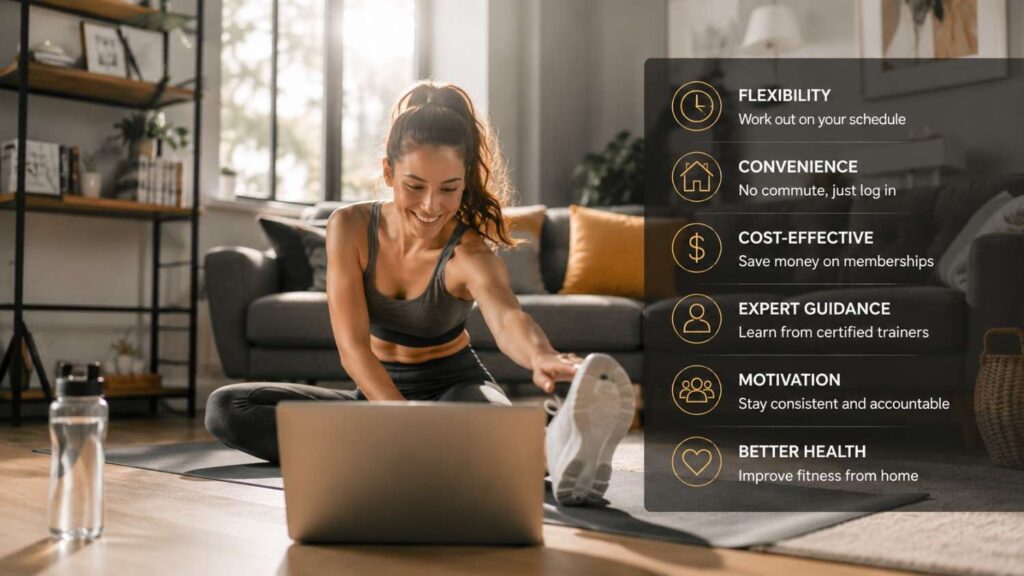
Benefits of Online Fitness Classes for Busy Beginners and Everyday Fitness
Benefits of Online Fitness Classes have become more important as people look for practical, flexible, and realistic ways to stay active. Many people want to improve their health, but they struggle with time, travel, gym confidence, family duties, work schedules, or the cost of regular in-person sessions. Online fitness classes solve many of these barriers by bringing structured exercise directly into the home.
In my experience, the people who stay consistent with fitness are not always the ones with the most motivation. They are usually the ones with the easiest system to repeat. If a workout requires long travel, a fixed gym timetable, and extra planning, it becomes easier to skip. If a class is available on a phone, laptop, tablet, or smart TV, the habit becomes easier to maintain.
Online workouts also give users more choice. A beginner can start with a 15-minute low-impact class. Someone more advanced can follow strength training, high-intensity cardio, or mobility sessions. A person returning after a break can choose gentle movement before building up again.
That is why the Benefits of Online Fitness Classes are not only about convenience. They are also about access, confidence, consistency, and personal control. When online fitness is chosen carefully, it can become a useful part of a balanced wellness routine.
Why Online Fitness Classes Are So Popular
Online fitness classes are popular because they fit around real life instead of forcing people to build their entire day around exercise. For many users, this is the biggest difference between starting a routine and maintaining one. A traditional gym routine can work very well, but it often requires travel time, fixed schedules, parking, changing rooms, equipment availability, and confidence in a shared space. Online fitness removes many of these obstacles.
Another reason for their growth is variety. A person can join a live online fitness class in the morning, complete an on-demand yoga session at night, or follow a short mobility routine during a work break. This level of choice makes online workouts useful for beginners and experienced users. It also helps people match the workout to their energy level, goal, and available time.
The popularity of virtual fitness classes also reflects a wider shift toward flexible wellness. People want services that are easy to access, simple to understand, and adaptable to different lifestyles. Online fitness supports this by allowing users to train at home while still receiving guidance, structure, and motivation. Health organisations continue to highlight the value of regular physical activity for overall health, and online classes can make that activity more achievable for people who struggle with traditional exercise settings.
They Save Time and Reduce Workout Barriers
One of the most practical Benefits of Online Fitness Classes is time saving. A gym workout may only last 45 minutes, but the full process can take much longer when travel, parking, changing, waiting for equipment, and returning home are included. For busy people, this extra time often becomes the reason they skip exercise altogether. Online fitness removes much of that friction because the class is available where the user already is.
This matters for parents, remote workers, students, freelancers, carers, and people with unpredictable schedules. A 20-minute class at home can feel more realistic than a full gym visit. It also makes it easier to build a habit because the starting point feels smaller and less stressful.
Online workouts also reduce mental barriers. You do not need to worry about what to wear, who is watching, or whether you know how to use gym equipment. You can simply open the class, follow the trainer, and move at your own pace.
They Make Fitness More Comfortable
Comfort is another major reason people choose online fitness classes. Many beginners feel nervous in gyms or group studios, especially if they are unsure about their fitness level, body confidence, or exercise technique. Online classes provide a private space where users can learn without feeling judged.
This is valuable because confidence often grows through repetition. A beginner can repeat the same class several times, pause the video, practise a movement slowly, or choose a lower-impact version. That level of control is harder to find in a busy in-person class.
Comfort also supports consistency. When exercise feels less intimidating, people are more likely to return to it. A quiet home environment can make movement feel more personal and less performative. For some users, online fitness becomes the bridge between inactivity and a more active lifestyle. It gives them space to build strength, coordination, and confidence before trying more advanced classes or gym-based training.
Main Benefits of Online Fitness Classes for Beginners
The Benefits of Online Fitness Classes are especially strong for beginners because they make fitness feel more approachable. Starting an exercise routine can be confusing. New users often ask what workout to do, how long to train, how hard to push, and whether they are doing the movements correctly. A well-structured online class can answer many of these questions by providing a clear plan, visual demonstrations, modifications, and a trainer-led format.
Beginners also benefit from having more control over pace. In an in-person class, it can feel awkward to stop, slow down, or choose an easier version. Online classes make this easier. You can pause, rewind, reduce intensity, or repeat a session until the movement feels natural. This helps users learn safely without feeling rushed.
Another advantage is choice. Online fitness classes for beginners often include low-impact cardio, stretching, yoga, pilates, mobility, chair workouts, and simple strength routines. These options allow users to begin at a realistic level instead of copying advanced routines that may be too demanding.
For beginners, the goal should not be perfection. The goal should be safe progress. Mayo Clinic advises people starting a fitness program to begin slowly, warm up, cool down, and build gradually as endurance improves. That principle fits very well with online classes because users can choose short, manageable workouts before increasing duration or intensity.
Beginner-Friendly Options Are Easier to Find
A major advantage of online fitness is the ability to search for the exact level you need. A beginner does not have to join a class designed for advanced users. Instead, they can choose beginner strength, low-impact cardio, basic yoga, gentle stretching, mobility, or bodyweight training. This improves safety and makes the experience less overwhelming.
Beginner-friendly online workouts usually include slower instruction, clear demonstrations, and modifications. For example, a trainer may show a regular squat and then offer a chair-supported version. They may explain how to keep the knees aligned, how to breathe, and when to rest. These details help users understand the movement rather than simply copy it.
This is useful for people who have not exercised for a long time. It is also helpful for users who want to rebuild fitness after a busy season, lifestyle change, or break from training. The right beginner class gives structure without pressure and helps users develop a routine they can sustain.
You Can Build Confidence Before Joining a Gym
Online fitness classes can act as a confidence-building step before joining a gym or studio. Many people avoid gyms because they feel unsure about basic exercises. They may not know how to squat, lunge, plank, stretch, or follow a warm-up. Online workouts provide a private way to practise these movements and learn the language of fitness.
This confidence matters. When users understand basic movement patterns, they feel more prepared in any exercise setting. They know how to modify a move, when to rest, and how to recognise the difference between normal effort and discomfort.
In my experience, confidence is one of the most overlooked parts of fitness. People often quit because they feel lost, not because they are lazy. Online classes can reduce that feeling by offering structure and repetition. Over time, users become more comfortable with their body, their breathing, and their ability to complete a session. That confidence often leads to better consistency and stronger long-term results.
How Online Workouts Support Health and Consistency
Online workouts support health by making regular movement easier to access. This is important because the benefits of exercise come from consistency, not from occasional intense effort. A person who completes three realistic online workouts every week is often building a stronger habit than someone who attempts one difficult workout and then stops for several weeks.
Regular physical activity is linked with several health benefits. The CDC states that physical activity can provide immediate and long-term benefits, including support for sleep, anxiety reduction, blood pressure, brain health, and chronic disease prevention. WHO also explains that physical activity includes movement done during leisure time, transport, work, and domestic tasks, which helps users understand that exercise does not have to be limited to a gym environment.
Online workouts are useful because they help users build structure around this movement. A person can follow a weekly plan with cardio, strength, stretching, and recovery sessions. This reduces guesswork and makes exercise easier to repeat. It also helps users connect fitness with daily routine. For example, a short morning workout can become part of the workday routine, while an evening mobility class can support relaxation.
The key is choosing workouts that match your level. Overly difficult classes can lead to frustration. Realistic classes create progress. This is where online fitness can be powerful because users can choose the class length, intensity, trainer style, and workout type that best fits their current needs.
Regular Movement Supports Physical and Mental Health
Regular movement supports both physical and mental wellbeing. Physical activity can help improve fitness, support daily function, and reduce health risks over time. The CDC notes that physical activity can help people feel better, function better, sleep better, and support thinking and learning as they age.
Online fitness classes can support these outcomes by helping people move more often. They are not a magic solution, but they can make exercise easier to repeat. This matters because many people know exercise is important but struggle to make it part of daily life. A short online class can lower the gap between intention and action.
Mental wellbeing is also important. Movement can provide a break from work, improve routine, and create a sense of achievement. For people who feel stressed or inactive, completing a manageable workout can be encouraging. The benefit is not only physical. It can also improve confidence, focus, and motivation.
Online Classes Help You Stay Accountable
Accountability is one of the main reasons online fitness classes work well for many users. A live class creates a scheduled commitment. You know when the session starts, what you need to do, and who is leading it. This structure can make it easier to show up, especially when motivation is low.
On-demand classes offer a different type of accountability. They allow users to follow a weekly plan, track completed sessions, and repeat workouts as needed. This is helpful for people whose schedules change often. Instead of missing exercise because they cannot attend a fixed class, they can move the session to another time.
Research into remotely delivered exercise also suggests that structured virtual exercise can be useful. A 2025 systematic review on videoconference exercise therapy for older adults found that it appeared safe, feasible, and effective for improving physical function, strength, emotional status, and quality of life compared with no intervention, while also noting limitations in the available research.
Online Fitness Classes vs Gym Workouts
The comparison between online fitness classes and gym workouts is not about declaring one option better for everyone. Both can be effective when they match the user’s goals, fitness level, budget, and lifestyle. The best choice depends on what the person needs most: convenience, equipment, privacy, coaching, social connection, or progression.
Online fitness classes are usually stronger for flexibility. They allow users to train at home, avoid travel, and choose shorter sessions. This makes them ideal for busy people, beginners, remote workers, parents, and anyone who wants a lower-pressure environment. They are also useful for activities that need limited equipment, such as yoga, pilates, mobility, stretching, low-impact cardio, dance fitness, and bodyweight strength.
Gym workouts are often better for people who need heavy weights, specialist machines, advanced programming, or in-person correction. A gym can also provide social energy and a dedicated training environment. Some users find that leaving the house helps them focus better.
A balanced approach can work well. Many people use online workouts for consistency during the week and gym sessions for heavier strength training or specialised equipment. This hybrid approach gives users the convenience of home workouts and the progression options of gym training.
| Feature | Online Fitness Classes | Gym Workouts |
|---|---|---|
| Convenience | High because classes can be done at home | Lower because travel is required |
| Privacy | High because users train in their own space | Lower in shared environments |
| Equipment | Often minimal or optional | Wider access to machines and weights |
| Trainer access | Live or recorded guidance | In-person coaching may be available |
| Schedule | Flexible, especially with on-demand classes | Depends on gym hours and class times |
| Best for | Beginners, busy people, home routines, low-impact fitness | Heavy lifting, machines, advanced coaching, social gym culture |
When Online Classes Are the Better Choice
Online classes are often the better choice when convenience and consistency are the main goals. If a person struggles to reach the gym, has limited time, works irregular hours, or feels nervous in group settings, online fitness can remove many common barriers.
They are also useful for people who want variety without committing to one studio. A user can do yoga on Monday, strength training on Wednesday, cardio on Friday, and stretching on Sunday. This variety can keep exercise interesting and reduce boredom.
Online classes also work well for people who travel. A simple bodyweight workout can be completed in a hotel room, living room, or quiet outdoor space. This makes it easier to maintain routine during busy periods. For users who value privacy and control, online classes provide a practical way to keep moving without the pressure of a public fitness environment.
When a Gym May Be Better
A gym may be better when the user needs equipment, supervision, or advanced progression. Heavy strength training often requires barbells, racks, benches, cable machines, and a range of weights. While some strength work can be done at home, gym equipment gives more options for long-term progression.
In-person coaching can also be valuable. A trainer can watch your form, correct technique, and adjust the workout immediately. This is especially useful for beginners learning complex lifts, people recovering from injury, or users with specific performance goals.
Some people also enjoy the gym atmosphere. Being around others can increase motivation and make exercise feel more social. A dedicated gym space can also help users separate workout time from home responsibilities. For these people, the best option may not be online fitness instead of the gym, but online fitness alongside the gym.
How to Choose the Right Online Fitness Class
Choosing the right online fitness class is important because not every class will match your body, goals, or experience level. A good class should feel challenging but manageable. It should explain what you are doing, why you are doing it, and how to modify the movement if needed. A poor class may move too quickly, skip warm-ups, offer no beginner options, or encourage unrealistic results.
The first step is to understand your goal. Are you trying to improve general fitness, lose weight, build strength, reduce stiffness, increase flexibility, manage stress, or create a sustainable routine? Different goals require different class types. For example, someone who wants flexibility may benefit from yoga or mobility classes, while someone who wants strength may need resistance training.
The second step is to check class level. Beginners should avoid advanced workouts that use complex exercises, fast transitions, or high-impact moves without modifications. More experienced users should look for progressive programs that build intensity over time.
The third step is to consider safety and instruction quality. Look for trainers who explain form, breathing, pace, warm-up, cool-down, and alternatives. Trusted guidance matters because exercise should support health, not create unnecessary risk. WHO and CDC physical activity guidance both highlight the value of regular aerobic and muscle-strengthening activity, so a complete online program should include a balanced mix rather than only one style of workout.
| Fitness Goal | Best Online Class Type | Recommended Frequency | Suitable for Beginners |
|---|---|---|---|
| Weight Loss | Cardio, HIIT (Low-Impact), Dance Fitness | 3–5 sessions per week | Yes (start with low-impact) |
| Muscle Strength | Bodyweight Strength, Resistance Training | 2–3 sessions per week | Yes |
| Flexibility | Yoga, Stretching, Mobility | Daily or 3–5 times weekly | Yes |
| Stress Relief | Yoga, Breathing Exercises, Pilates | 2–5 sessions per week | Yes |
| Better Heart Health | Cardio, Aerobic Exercise, Walking Workouts | 150 minutes weekly | Yes |
| General Fitness | Mixed Strength and Cardio Classes | 3–4 sessions per week | Yes |
Check Instructor Quality and Class Level
Instructor quality can strongly affect the value of an online fitness class. A good instructor does more than demonstrate exercises. They explain proper form, give clear cues, offer modifications, and remind users to listen to their bodies. This is especially important online because the trainer may not be able to correct each person individually.
Beginners should look for classes labelled “beginner,” “low impact,” “foundation,” or “introductory.” These classes are more likely to include slower pacing and safer progressions. Advanced users can choose more demanding classes, but they should still look for good instruction and proper warm-up time.
It is also wise to avoid classes that promise extreme results in a very short time. Fitness progress usually requires consistency, recovery, and gradual improvement. Mayo Clinic recommends starting slowly and building up gradually when beginning a fitness program. A reliable online trainer should follow that same principle.
Match the Format to Your Goal
The right format depends on your goal. For strength, choose online strength training, resistance band workouts, dumbbell classes, or bodyweight sessions. For flexibility, choose yoga, pilates, stretching, or mobility work. For heart health and stamina, choose cardio, dance fitness, step workouts, or low-impact aerobic sessions.
Users should also consider their energy level and schedule. A 15-minute class may be more useful on a busy day than skipping a longer workout altogether. On quieter days, a 45-minute session may be more suitable. This flexibility is one of the main Benefits of Online Fitness Classes because it allows people to adapt exercise to real life.
A complete routine should include variety. Cardio supports endurance, strength training supports muscles and function, and mobility helps movement quality. Adults are generally encouraged to include aerobic activity and muscle-strengthening activities each week, so online fitness users should avoid relying on only one workout style.
Step-by-Step Plan to Start Online Fitness Classes Safely
Starting online fitness classes safely requires a simple plan. Many people make the mistake of doing too much too soon because they feel excited at the beginning. That approach can lead to soreness, frustration, or loss of motivation. A better method is to begin with short, realistic sessions and build gradually.
The first step is to choose your goal. Do you want more energy, better mobility, weight management, strength, stress relief, or general health? Once the goal is clear, choose class types that support it. A beginner may start with low-impact cardio, gentle strength, stretching, or yoga. An experienced user may choose structured strength or interval training.
The second step is to set a weekly schedule. Three sessions per week is a reasonable starting point for many beginners. Each class can last 15 to 30 minutes. As fitness improves, users can increase duration, intensity, or frequency.
The third step is to prepare your space. Clear the floor, check your internet connection, keep water nearby, and position the screen where you can see the instructor. If using weights or resistance bands, make sure you have enough room to move safely.
The fourth step is to warm up and cool down. NHS guidance explains that warming up before exercise can help prepare the body and make workouts more effective. This is especially important when training at home without direct supervision.
| Checklist Item | Why It Matters | Recommended Action |
|---|---|---|
| Choose a Beginner Class | Prevents injury and frustration | Start with beginner-level sessions |
| Clear Workout Space | Improves safety | Remove furniture and obstacles |
| Wear Comfortable Clothing | Allows free movement | Choose breathable workout clothes |
| Keep Water Nearby | Supports hydration | Drink water before, during, and after exercise |
| Warm Up First | Prepares muscles and joints | Spend 5–10 minutes warming up |
| Use Proper Form | Reduces injury risk | Follow instructor demonstrations carefully |
| Listen to Your Body | Prevents overtraining | Stop if you feel sharp pain or dizziness |
| Track Progress | Builds workout consistency | Record completed workouts each week |
Follow a Simple First-Week Plan
A simple first-week plan can help beginners start without feeling overwhelmed. The goal should be consistency, not intensity. Choose three beginner-friendly classes and place them on non-consecutive days. For example, you might do low-impact cardio on Monday, beginner strength on Wednesday, and stretching or yoga on Friday.
Keep each workout short. A 15 to 30-minute class is enough to build the habit. Focus on learning the movements, understanding your breathing, and noticing how your body responds. Avoid comparing yourself to the instructor or other users.
A safe first-week plan may look like this:
- Choose 3 beginner classes for the week.
- Keep each session between 15 and 30 minutes.
- Rest or do gentle walking between harder sessions.
- Warm up before each class.
- Stop if you feel sharp pain, dizziness, or unusual discomfort.
- Write down how you feel after each workout.
This approach helps users build confidence while reducing the risk of doing too much too soon.
Create a Safe Workout Space
A safe workout space makes online exercise more comfortable and effective. You do not need a large room, but you do need enough space to move without hitting furniture, slipping, or tripping. Clear the floor before starting and remove loose rugs, bags, cables, or objects that could get in the way.
Good lighting also helps. You should be able to see the screen clearly and check your body position when needed. Some users place a mirror nearby to monitor form, but this is optional. If the class includes floor work, a mat can improve comfort. If the workout includes jumping or fast movement, supportive shoes may be useful.
People with chronic health conditions, injuries, balance issues, or long periods of inactivity should take extra care before starting a new routine. Mayo Clinic advises people with chronic conditions to speak with a healthcare professional about safe exercise options. Online fitness can be helpful, but safety should always come first.
AEO Summary: Are Online Fitness Classes Worth It?
Online fitness classes are worth it for many people because they make exercise easier to start, easier to repeat, and easier to personalise. They are especially helpful for users who value flexibility, privacy, beginner-friendly instruction, and convenience. They are not perfect for every goal, but they can be a strong solution for general fitness, habit building, and home-based wellness.
The answer depends on the user’s needs. If someone wants heavy barbell training, specialist machines, or hands-on form correction, a gym or in-person coach may be better. If someone wants flexible workouts, less travel, and a lower-pressure environment, online fitness classes may be the better fit.
From an AEO perspective, the direct answer is simple: online fitness classes are worth it when they help a person move more consistently and safely. The value comes from reducing barriers. When a workout is easy to access, people are more likely to complete it.
The best online fitness experience usually includes a balanced mix of cardio, strength, flexibility, and recovery. It should also include clear instruction, progress tracking, and realistic expectations. Users should choose classes that match their level and avoid programs that promise quick or extreme results.
Overall, the Benefits of Online Fitness Classes are strongest when users treat them as part of a sustainable lifestyle, not a short-term challenge.
Best Use Cases for Online Fitness Classes
Online fitness classes are ideal for busy people who need exercise to fit into limited time. They are also useful for beginners who want privacy while learning basic movements. A person can start with short sessions and gradually increase the challenge as confidence grows.
They are also helpful for remote workers. Sitting for long hours can make people feel stiff and low in energy. A short lunchtime mobility class or evening strength workout can help break up the day. Online classes are also useful for parents who cannot easily leave home, frequent travellers, and people who live far from gyms or studios.
Another strong use case is low-impact fitness. People who prefer gentler movement can choose yoga, pilates, walking-style cardio, stretching, or chair-based workouts. This variety makes online fitness adaptable to different needs.
The best results come when users choose classes that match their lifestyle. A realistic routine done consistently is more valuable than an ambitious routine that is quickly abandoned.
Main Limitations to Consider
Online fitness classes have limitations, and users should understand them before starting. The biggest limitation is the lack of hands-on correction. In a live gym or studio, a trainer can adjust your form. Online, the trainer may not see your movement clearly, especially in recorded classes.
Another limitation is equipment. Some advanced strength goals require heavier weights, machines, or progressive resistance that may not be available at home. While bodyweight exercises and resistance bands can be effective, they may not meet every training goal.
Motivation can also be a challenge. Some people need the atmosphere of a gym or the social pressure of an in-person class. Online fitness requires a certain level of self-direction.
These limitations do not make online classes ineffective. They simply mean users should choose carefully. A good solution may be a hybrid approach that combines online workouts with occasional gym sessions, outdoor activity, or in-person coaching.
Quick Answer About Benefits of Online Fitness Classes
The main benefits of online fitness classes include flexibility, convenience, privacy, lower travel time, easier access to trainers, and better workout consistency. They make exercise easier to fit into daily life because you can join a live or recorded class from home, work, a hotel room, or any suitable space. This is helpful for beginners, busy professionals, parents, older adults, and people who feel uncomfortable in crowded gyms.
Online classes can include yoga, pilates, cardio, mobility, stretching, dance, strength training, low-impact workouts, and beginner-friendly fitness plans. They also allow people to repeat lessons, pause when needed, and choose sessions based on their current fitness level. Trusted health bodies recommend regular aerobic and muscle-strengthening activity for adults, so online fitness can be a practical way to build a consistent routine when used safely and realistically.
Frequently Asked Questions
The following FAQs answer common user questions about online fitness classes, virtual workouts, home exercise routines, and beginner-friendly training. These questions are useful for readers who want clear answers before choosing an online class, app, trainer, or subscription. They also support voice search and answer engine optimisation because many users search in natural question format.
When answering these questions, it is important to avoid unrealistic claims. Online fitness classes can be effective, but results depend on consistency, exercise selection, personal effort, safety, nutrition, sleep, and individual health needs. A well-designed online routine can support general fitness, strength, flexibility, mobility, and motivation. However, users with medical conditions or injury concerns should seek personalised medical or professional advice before starting a new program.
What are the main benefits of online fitness classes?
The main benefits of online fitness classes include flexibility, convenience, privacy, lower travel time, access to different workout styles, and better workout consistency. They allow users to exercise from home without depending on gym opening hours or travel time. This makes them useful for beginners, busy professionals, parents, students, and people who prefer private training.
Another benefit is variety. Users can choose yoga, pilates, cardio, strength training, stretching, mobility, dance fitness, or low-impact workouts. This makes it easier to find a class that matches fitness level and personal preference. The best results come when the class is realistic, safe, and repeated consistently.
Are online fitness classes effective?
Yes, online fitness classes can be effective when they are followed consistently and matched to the user’s level. They can support cardio fitness, strength, flexibility, mobility, and general wellbeing. The key is choosing classes with clear instruction, safe pacing, warm-ups, cool-downs, and suitable progression.
Effectiveness also depends on personal effort. A beginner doing three realistic online workouts per week may build a stronger habit than someone who chooses advanced classes and quits quickly. For best results, users should combine online workouts with daily movement, recovery, proper sleep, and a balanced lifestyle. Online classes are a tool, and their value depends on how well they are used.
Are online fitness classes good for beginners?
Online fitness classes are often very good for beginners because they reduce pressure and allow users to learn at their own pace. A beginner can pause the video, repeat a class, choose a lower-impact version, or practise privately before moving to harder workouts. This makes the process less intimidating.
Beginners should choose classes labelled as beginner, low-impact, foundation, or introductory. They should avoid advanced workouts with fast transitions, heavy equipment, or complex movements until they build confidence. A good beginner class should explain form clearly, offer modifications, and encourage gradual progress. Starting slowly is usually safer and more sustainable than trying to do too much in the first week.
What equipment do I need for online workouts?
Many online workouts require little or no equipment. For beginner classes, a mat, water bottle, towel, and comfortable clothing are often enough. Some workouts may use light dumbbells, resistance bands, yoga blocks, a chair, or ankle weights, but these are not always necessary.
Before starting, users should read the class description and prepare the space. If the workout includes jumping or fast movement, supportive shoes and a non-slip surface may be helpful. If the class includes strength training, the instructor should explain how to use equipment safely. Beginners should start with simple tools and only add equipment when they understand the movements.
Are online fitness classes better than gym workouts?
Online fitness classes are better for convenience, privacy, schedule flexibility, and home-based routines. They are useful for people who want to exercise without travel, crowded spaces, or strict class times. They are also helpful for beginners who want to build confidence before joining a gym.
Gym workouts may be better for heavy lifting, specialist machines, in-person coaching, and advanced progression. A gym also provides a dedicated training environment, which some people find motivating. The best choice depends on personal goals. Many users benefit from a hybrid routine that uses online classes for consistency and gym workouts for equipment-based training.
How many online fitness classes should I do each week?
A good beginner target is three online fitness classes per week. Each session can be 15 to 30 minutes at first. This helps users build a routine without feeling overwhelmed. As fitness improves, they can increase the number of sessions, class length, or intensity.
A balanced weekly routine should include different types of movement. For example, one cardio class, one strength class, and one mobility or stretching class can be a good starting point. Adults are generally encouraged to include both aerobic activity and muscle-strengthening activity each week, so variety is important.
How do I choose a safe online fitness class?
To choose a safe online fitness class, start by checking the level, instructor quality, class description, and workout style. Beginners should choose low-impact or beginner classes with clear demonstrations and modifications. Avoid classes that promise extreme results quickly or push users to ignore pain.
A safe class should include a warm-up, clear movement cues, rest options, and a cool-down. The trainer should explain how to adjust exercises for different ability levels. Users should also prepare their space, wear suitable clothing, and stop if they feel sharp pain, dizziness, or unusual discomfort. Safety is more important than completing every movement perfectly.
Conclusion
The Benefits of Online Fitness Classes go far beyond simple convenience. They help people remove common exercise barriers, build confidence, save time, and create a routine that fits real life. For beginners, online classes offer privacy and control. For busy people, they provide flexible access. For experienced users, they offer variety and a practical way to stay consistent when travel, work, or family schedules get in the way.
Online fitness is not a perfect replacement for every type of training. Some people still need gym equipment, in-person coaching, medical supervision, or hands-on technique correction. However, for general health, home workouts, beginner fitness, mobility, cardio, yoga, strength basics, and routine building, online classes can be highly useful.
The best approach is to choose safe classes, start at the right level, include both cardio and strength, warm up properly, and build gradually. When used with realistic expectations, online fitness can become a sustainable part of a healthier lifestyle.
If your goal is to move more often without making fitness feel complicated, online classes are one of the most accessible options available. They allow you to start where you are, use the time you have, and build progress step by step.